As the CEO and Founder of Molfar, Artem Starosiek is an expert in OSINT investigations, with over a decade of experience in the field. He specialises in digital security, due diligence, open-source research, and more. Artem is also an owner and publisher of AIN.UA, one of the major Ukrainian IT media outlets.
The Molfar team conducted research under the guise of a legend. We have collected insider information about the features of work, service, payment and use of services from the inside. The most complete overview of all the nuances of providing cloud storage services from 17 providers of Ukraine. Meaningful information for companies that want to build remote work in connection with Russia's military aggression against Ukraine.
We also compared the valuation of companies in 2022 with our valuation of the same companies in 2021. You can look at the dynamics of changes in the quality of services in the company. Spoiler: the market leaders are gradually surrendering positions.
2026 Update: What Has Changed
The ranking below reflects Molfar’s 2022 research and has not been retested. This update provides current market context rather than a new provider ranking.
Ukraine’s cloud market has expanded substantially. An IT Ukraine Association market review estimates IaaS and PaaS consumption at UAH 7.2 billion in 2025, compared with UAH 1.3 billion in 2021. Including donor-funded capacity, the total may exceed UAH 10 billion.
The competitive landscape has also changed. Kyivstar launched its cloud platform in 2025, while in July 2026 Ukraine’s competition authority authorised the company to acquire control of GigaCloud, subject to specific commitments. DataGroup and Volia have operated within a combined telecom group since 2024.
Regulation has become more structured, particularly for public-sector and restricted data. At the same time, persistent cyberattacks and energy-related disruptions have made resilience a central selection criterion.
Businesses choosing a cloud provider in 2026 should assess geographic redundancy, disaster recovery, immutable backups, cybersecurity controls, data location, contractual responsibilities and exit procedures. The 2022 results remain a historical snapshot; current provider capabilities and commercial terms should be verified separately.
Preparation for research, evaluation rules and legend
The study began in February 2022
In connection with the invasion of Russia on the territory of Ukraine on February 24, the study was stopped. In July 2022, we continued to analyze the indicators and finally completed the study.
In connection with Russia's military aggression, most IT companies with offices in the east of Ukraine faced the need to relocate employees to other regions, as well as to organize the work process remotely, which requires access to cloud services.
Legend
The application to providers is made on behalf of an IT company that wants to open an R&D (Research and Development) department for remote employees (5-10 people), to optimize the work process, the development will take place in a cloud storage.
Research task
To obtain technical specifications, test access to the service. The request was sent to 17 companies.
Research results
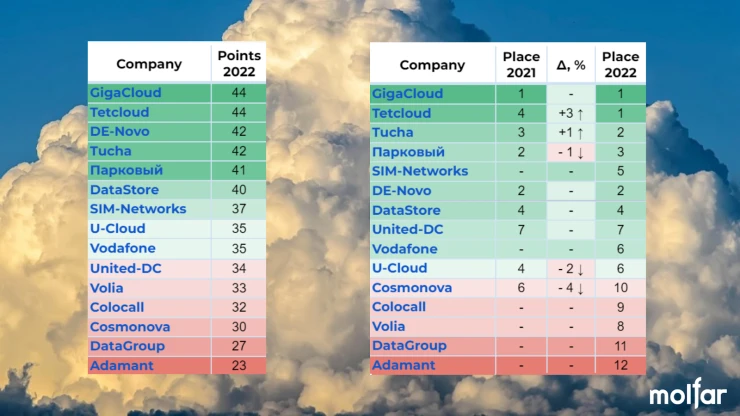
By the sum of points, GigaCloud and Tetcloud shared the first place. GigaCloud received the highest number of points in the Reaction and Terms of the CO category. Tetcloud received the highest ratings for technical support work in the categories “Contract signing” and “Technical part”. The second place was shared by “De Novo” and “Tucha”, also receiving high scores in the categories “Reaction and conditions of the CO” and “Technical part”. The third place was taken by Parkovy, having received high scores for the work of technical support in all three categories. Median – 35 points.
Outsiders
Received the lowest score for technical support work in the “Technical Part” category. In the CO Terms category, Adamant shared a low score with Volia. In the Contract Signing category, DataGroup, DataStore, Adamant, and UCloud received the lowest scores
To compare the current performance of companies with those for the previous year, the scores for the same company indicators for 2021 and 2022 were summed up:
Ranking by sum of points for all items (left), comparison of the current performance of companies with those for the previous year (right)
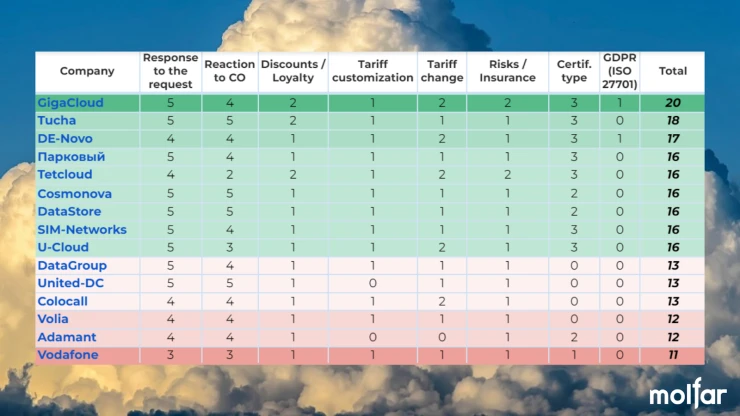
Reaction and conditions of CO
GigaCloud took the first place in the category, Tucha took the second place. Both companies promptly responded to the request and responded as soon as possible: GigaCloud within 5 hours, Tucha – within 1 hour. Both companies also received the maximum number of points for having a discount system and loyalty in the form of deferred payment if necessary. GigaCloud is more flexible when changing the tariff – the user can change the tariff on his own in his personal account, while Tucha needs to contact technical support to change the tariff.
Also, using GigaCloud, the user is better insured in case of downtime or data loss – the company compensates 10% of the cost of client services for every 30 minutes of downtime, the maximum amount of compensation is the monthly cost of the service. Tucha only reimburses the daily cost of the service when the problem was discovered.
GigaCloud also complies with the ISO 27701 data protection standard (GDPR). The third place was taken by “De Novo”, which also quickly responded to the request, answering the client within 5 hours. “De Novo” received the maximum number of points for having an ISO 27701 certificate, as well as for the ability to change the tariff in the user's personal account, but did not get the maximum number of points for other points.
The outsiders were Volia, Adamant and Vodafone, which responded relatively quickly to the request, but otherwise did not score. Volia does not have certification, it is not possible to change the tariff through the user's account, and the service automatically stops working if there are no funds on the account. Vodafone is more loyal, they turn off the service only after notification of non-payment within 10 days, however, there is also no possibility of changing the tariff in the user's account, and of the certification types, only ISO 27001. Adamant responded to the request faster than Vodafone, but they do not provide customization and tariff change, also the service is automatically blocked in the absence of funds on the account.
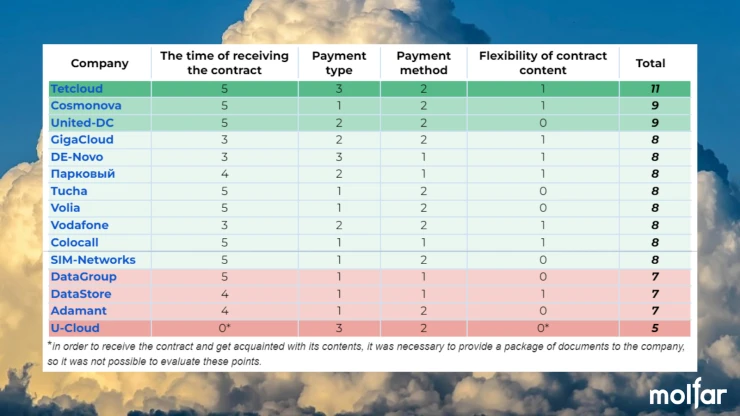
Terms of signing the contract
Tetcloud became the leader in terms of the terms and conditions for signing the contract, with an advantage in the speed of providing the contract, as well as in the additional payment method «pay as you go» – hourly payment for the resources used. 2nd place was shared between Cosmonova and United-DC, who also quickly provided the contract for signing, however, Cosmonova have limited options in the «Payment Type», namely, they work only on prepaid, and United-DC refused a request to correct the contract due to the terms of payment, which is why they received 0 points in the item «Flexibility of contract content».
DataGroup, DataStore and Adamant scored the least points in this category, which offer only the option of prepaid for services, without the possibility of «pay as you go» and post-payment, and only bank transfer is possible among the payment methods. Also, DataGroup and Adamant did not agree to amend the contract on the terms of payment at the request of the client, which is why they received 0 points in the «Flexibility of the content of the contract» clause.
Technical part / testing
Four companies became leaders in this category: De Novo, Parkovy, Tetcloud and DataStore. De Novo and DataStore provided test access faster than Parkovy and Tetcloud – within 1-5 hours, Parkovy and Tetcloud – within 1 day.
All four companies received the highest score in the “User autonomy” item, which means that the user has access to the virtual machine (VM) management system, the ability to configure the virtual server on their own. Also, all four companies received the maximum scores for the quality of technical support, which indicates a high level of interest of technical support specialists in helping the client.
Outsiders in this category are DataGroup, Cosmonova and Adamant. Despite the high speed of providing a test period and the average level of user autonomy, DataGroup received 0 points for the lack of a user manual, API, infrastructure management capabilities using orchestrators, and a low level of technical support interest. Cosmonova and Adamant, in turn, received good scores for the quality of technical support and the average level of user autonomy, however, they did not get points on all other points.
Pre-employment checks may take from several working days to several weeks, depending on the scope, role, jurisdictions, and sources involved. This guide explains typical UK screening timelines and the factors that can delay completion.
Molfar Intelligence conducted a market research of IaaS providers in Ukraine. GigaCloud, Parkovyi, De Novo, Tucha and Tetcloud took the leading positions.
{ "@context": "https://schema.org", "@type": "Article", "headline": "The best cloud services of Ukraine in 2022: Molfar's research", "description": "The Molfar team have collected insider information about the features of work, service, payment and use of cloud services from 17 providers in Ukraine, including analysis of performance and service quality.", "url": "https://molfar.com/news-posts/the-best-cloud-services-of-ukraine-in-2022-molfars-research", "mainEntityOfPage": { "@type": "WebPage", "@id": "https://molfar.com/news-posts/the-best-cloud-services-of-ukraine-in-2022-molfars-research" }, "image": "https://cdn.prod.website-files.com/691b42338062a4c31a487ce2/69fc456090512eae5e6fd1cd_7.webp", "datePublished": "2022-08-04", "dateModified": "2026-05-05", "articleSection": "Analytics", "inLanguage": "en", "timeRequired": "PT9M", "author": { "@type": "Person", "name": "Artem Starosiek", "description": "CEO and Founder of Molfar Intelligence, expert in OSINT investigations, digital security, due diligence, and open-source research." }, "publisher": { "@type": "Organization", "name": "Molfar Intelligence" }, "articleBody": "The Molfar team conducted research under the guise of a legend. They collected insider information about the features of work, service, payment and use of cloud services from 17 providers in Ukraine. The research provides a comprehensive overview of cloud storage providers and their service quality, pricing, and technical capabilities.\n\nThe study began in February 2022 and was paused due to Russia’s invasion of Ukraine, later resuming in July 2022. Many IT companies were forced to relocate and switch to remote operations, increasing demand for reliable cloud services.\n\nThe research evaluated providers based on several categories including reaction time, contract terms, technical support, flexibility, and technical infrastructure. Leaders included GigaCloud, Tetcloud, De Novo, Tucha, and Parkovy, while several providers showed weaker performance in areas such as certification, contract flexibility, and technical support.\n\nKey evaluation areas included reaction speed to client requests, discount and payment systems, SLA conditions, ISO certifications, downtime compensation policies, and the ability to change tariffs via user accounts.\n\nContract evaluation showed Tetcloud as a leader due to flexible payment models including pay-as-you-go, while companies like DataGroup and Adamant scored lower due to rigid prepaid-only models and lack of contract flexibility.\n\nTechnical testing highlighted De Novo, Parkovy, Tetcloud, and DataStore as leaders due to fast test access provisioning, strong technical support, and high user autonomy. Outsiders lacked proper documentation, APIs, or sufficient infrastructure management tools.\n\nThe research concludes that the Ukrainian cloud services market is evolving under wartime pressure, with leaders gradually strengthening their positions while others lag behind in flexibility and technical maturity."
}









.svg)
.svg)